Teaching Sciences by Ocean Inquiry
Introduction
The world’s ocean affects human life in many ways. It regulates the earth’s climate, affects weather, and provides food. It is source for recreation, inspiration, and exploration. Students' fascination with the ocean -- coupled with the multidisciplinary nature of ocean sciences -- provides a superb platform for teaching general science using inquiry-based methods.
|
||
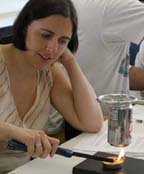
The COSEE summer workshop "Teaching Sciences by Ocean Inquiry" was developed to A) introduce teachers to ocean and climate related processes that can be used as a vehicle to teach general physical concepts (e.g. density, buoyancy, pressure, heat and temperature, waves) through a variety of hands-on activities, and B) establish a network between teachers, scientists and experts in education.
During this five-day workshop, the teachers reviewed physical concepts through hands-on exploration, examined links between physical concepts and ocean processes, and developed inquiry-based activities for teaching sciences. Attendees worked directly with University of Maine (UMaine) faculty to develop hands-on, inquiry-based activities, teaching materials, and means of assessment (to address the Maine Learning Results and National Science Educational Standards) via lab exercises and classroom discussions.
This workshop was presented at the Darling Marine Center (DMC) in 2006-2008 by the UMaine School of Marine Sciences and COSEE-OS, with support from the College of Education & Human Development and the National Science Foundation . The DMC is located on the Damariscotta River estuary in Walpole, Maine and consists of state-of-the-art educational, research, and conference facilities, seawater laboratories and classrooms, research vessels, a marine library, dining hall, and housing facilities.




