
 |
|
|

|
|
|
|
|||||||||||||||||||||||||||||||||||
|
SEARCH | WEBINARS | |
|||||||||||||||||||||||||||||||||||
|
|
COSEE-OS engages audiences in free public webinars to help scientists and ocean science content reach broader audiences. Since 2010, we have pioneered several webinar models, and continue to test the application of webinars to different audiences. All that is needed to participate in a scheduled webinar is a phone and an internet connection. Participants can ask questions and participate, making the session both interactive and informative.
Seawater's composition reflects our planet’s history, along with traces of human impacts. The chemistry of trace elements - found in such small concentrations that they can be difficult to detect - can be studied to uncover the past, present and the future of the ocean and life within it. This four-part GEOTRACES webinar series focused on several trace elements and what they can tell us about biogeochemical processes, the carbon cycle, and climate. Nine scientists, each studying a unique facet of the ocean’s chemistry, shared their work and the importance of researching these rare and vital “clues” from the ocean.
Marine debris is quickly becoming a hot topic in the scientific community, but most of what the public sees comes in the form of sensationalized media: images of water bodies covered in visible trash, talk of a giant “garbage patch." How much truth is there to these stories? Most importantly, what is the science telling us? View the archives of this two-part webinar series to hear from three prominent scientists researching plastic pollution at the microscopic level and learn about how computer models can be used to accurately predict where debris will go, once it reaches the ocean.
Everyone knows that the ocean is salty, but did you know that salt is essential to the recipe for our entire climate and life on Earth? View our six-part webinar series to find out how SPURS (Salinity Processes in the Upper Ocean Regional Study) scientists seek to better understand ocean salinity, which affects everything from the water cycle to climate change. Each webinar features an interactive concept map loaded with educational resources that can serve as a starting point for you to "sprinkle" ocean salinity into your teaching. We also identify applicable Next Generation Science Standards (in development).
From "white-knuckle" plane flights to the soothing swirl of cream in your coffee, turbulence is an ever-present part of our daily lives. But how much do you know about it? Designed for physics, math and science educators, these webinars contain information on the physics of turbulence as well as its effect on life including:
Each webinar features an interactive concept map filled with resources for use in the classroom, including videos, images and other resources.
Dig deeper by watching this three part series to discover more about the mysterious organisms that lurk beneath the water-sediment interface, and why scientists believe their investigations into the physiology and behaviors of these benthic organisms can shed light on larger-scale ecosystem functioning. Great for biology, ecology, ocean science, marine science educators, these webinars contain content relating to benthic organisms, ecological impacts from human activities, as well as new technology and the latest research techniques. Each webinar features a scientist sharing their knowledge via an interactive concept map, filled with resources for use in the classroom, including time-lapse movies, lesson plans, images and inquiry-based data activities.
This dynamic webinar series features the research of scientists from the 2008 North Atlantic Bloom (NAB) Experiment and focuses on key concepts in ocean science. The five-part weekly series consists of presentations from NAB scientists, and tells the story of the North Atlantic spring bloom and its role in the ocean ecosystem. It describes the multi-faceted nature of this complex experiment and provides a rich body of educational resources, including linked concept maps aligned to National Science Education Standards, and datasets that can be translated into classroom activities.
Research-based Online Learning Event (ROLE) Model webinars include a presentation by a research scientist who has developed a concept map specifically for the webinar on relevant science topics, cutting-edge research or specific interest areas, which includes a rich collection of multimedia assets. The first eight webinars also feature educators who share the unique and varied ways they have used concept mapping in their classroom, informal, or other learning environment. Unlike traditional slide-based presentations, these dynamic maps act as a resource that can be explored with an audience, instead of a one-way, linear presentation. The concept maps presented are loaded with educational assets from the our Ocean Climate Interactive database - including images, videos, news items - that webinar participants can use in their own educational practices, presentations or for their own learning. The concept maps and other materials presented are freely available online, and instructions are provided to give participants access to the maps after the webinars.
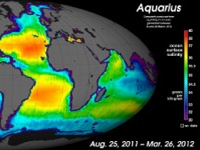
June 2011 marked the launch of NASA's first space-based measurements of ocean salinity across the globe - an important observation for ocean and climate studies. From 650 kilometers (400 miles) above Earth's surface, Aquarius detects changes in ocean salinity as small as a "pinch" of salt in a gallon of water. NASA Aquarius works closely with COSEE-OS for its Education and Public Outreach endeavors. These webinars cover the science, engineering and observations made by the satellite before and after launch, as well as methods used by educators to teach key oceanographic concepts using Aquarius concepts. Many Learning Pathways in the Ocean Sciences COSEE-OS in collaboration with the Institute for Broadening Participation conducts various types of webinars for sharing successful strategies for increasing diversity in the ocean sciences community. During some events, for example, presenters talk about their science topics as well as their experiences as an under-represented minority in a science field, and/or their experience providing mentorship to under-represented minorities. Webinar presenters also share insights from the professional literature to emphasize how learners benefit from multiple support structures to strengthen and broaden their personal and intellectual development. Other webinars in this series are designed to provide "nuts and bolts" information for target audiences of new faculty, post-doctoral researchers and graduate students in ocean sciences and geosciences.
|
||||||||||||||||||||||||||||||||||||

|
|
|||||||


